Has someone ever confronted you with something you said which made you realize the unintended effect of your words?
Bear with me. I will get to my point.
There is a startling scene in an episode of the television series Breaking Bad in which scores of men of various ages are shown crawling on their bellies on the dusty ground. Slowly yet steadily they lurch forward like strange reptiles toward who-knows-what. Eventually, we see that a small sanctuary is their destination, and we understand that the stomach crawling is a sacrifice or offering to Santa Muerte (St. Death) in exchange for the grant of a decidedly un-Christian favor. [A 2013 National Geographic article by Alma Guillermopietro – “Vatican in a Bind About Santa Muerte” – covers the reaction of the Vatican to the controversial cult of Santa Muerte.]
In real life, in several countries around the world, devotees of a particular Madonna or saint are known to walk on their knees for long distances as they make their way to a shrine. I’ve read that, in Mexico, some folks attach paddles of thorny cactus to their backs as their sacrifice. The Breaking Bad scene of the stomach crawlers apparently was heightened for dramatic effect – but just a little.
There are less brutal ways to invoke the help of a saint or the Virgin Mary.
A couple of years ago, while vacationing in my old stomping grounds in Southern Italy, my wife and I walked into a small church where we hoped to find my cousin. She was there all right, deeply engaged in saying the “Hail Mary” prayer with about a dozen other people, all with rosaries in hand. They did not say the prayer once or twice – they kept repeating it non-stop. For each bead on the rosary, the prayer was repeated. I don’t know if the people were all praying for the same thing or person or how many times they prayed an entire rosary.. Most likely the praying was part of a novena, which involves praying for nine days.
My wife and I stayed in the church about five minutes, and the praying droned on and on. I never did get my cousin’s attention. The repetition was hard to take.
We were about a block away from the church when we encountered Giacomo, whom I considered a close friend in my youth. He said he was rushing to the church for the upcoming mass.
That’s when I launched my tirade (my wife always says I need to take a moment before speaking the thoughts that pop into my mind, but I don’t). “Giacomo, tell me something. Why do those people repeat the ‘Hail Mary’ over and over? What good does it do?”
Giacomo looked a little uncomfortable. He said, “They believe it will help. My wife and I often ―”
“Help what?” I interjected. I went on and on about how it made no sense to spend hours in a church, repeating a prayer as if it were a magic spell. I even said that it seemed a silly thing to do. Giacomo said nothing, and at the first chance, excused himself and hurried toward the church.
My wife immediately told me that, if praying helps people withstand the difficulties that life hurls at them, who were we to criticize or make fun of them for that. I objected. I made fun of no one, I said.
“I don’t think Giacomo saw it that way,” she replied.
There is a mountain-top sanctuary to a Madonna that is known throughout Catholic Europe. In its heyday, the Sanctuary of Montevergine was the biggest religious draw in Italy – aside from the Vatican – for Catholics from all over. Throughout WWII, the sanctuary even served as a hiding place for the Shroud of Turin.
The sanctuary has lost some of its popularity since the opening of the shrine for Padre Pio at San Giovanni Rotondo, but it reportedly still draws about 1.5 million visitors per year. If you ever go there, I recommend seeing the Ex-voto room, where the walls are covered with silver renditions of hands, arms, legs, hearts, and lungs, testaments to the Virgin’s healing powers. [FYI, in ancient Roman times, people who successfully invoked the help of Aesculapius, the god of healing, would put up similar votives in the temples dedicated to him.] By the way, the views of the valley below are spectacular.
In the past, some folks would make the pilgrimage to Montevergine barefoot, starting at the foot of the mountain, or even from towns further away. One of my uncles walked (wearing shoes) from Naples to Montevergine to thank the Madonna for helping his wife recover from an illness. That’s a distance of about 51 km or 32 miles. I, too, once ascended the mountain (barefoot) when one of my sisters recovered from brain surgery after I had prayed for a successful outcome.
Recently, when I was discussing these sacrifices with my wife, she had a skeptical look on her face.
“Pope Leo (XIV) just said that the Virgin can show us how to bring comfort, help, and affection to others who are suffering. Something about making the right choices that allow us to be present where another ‘is most wounded.’ So it seems to me that this hurting oneself in honor of the Virgin makes zero sense.”
I objected, pointing out that it is about keeping a promise to the Virgin in honor of her intercession.
“But Christ was about people helping each other. Doesn’t it make more sense that the Madonna would prefer that, instead of hurting oneself, a person promised to help someone else in need? Like, someone who struggles to feed herself and her family, to help her for six months or a year?”
“What if the person praying to the Virgin is just as poor?” I protested.
“That’s why it’s called ‘sacrifice,’ and, besides,” she responded, “the gesture can be as small as providing a few eggs a week to someone else, or giving them rides to the store, or just offering a little companionship to someone who has no one. Wouldn’t that honor and please the Madonna more than making your feet bleed and blister?”
I remained unconvinced. Acts of self-sacrifice have been going on for centuries. Why upend that now, even if what my wife said made some sense?
I felt as if she had attacked one of my core beliefs. Then Giacomo came to mind.
Oh, no, what had I done?
Let me know if you like this post and if you have a comment. Has anything similar happened to you?
Do you like stories about curses, steamy settings, and alluring people with mysterious powers? Are you interested in the early days of rock and roll and the hard road to fame? E.E. Mazier’s new novel, Johnny Moon and the Black Dog Queen, offers all that and more. Now available as a paperback and on Kindle at Amazon. Note: In Jan. 2026 price of the paperback will increase to meet requirements for Expanded Distribution. Buy before Jan. 1 to beat the price increase!
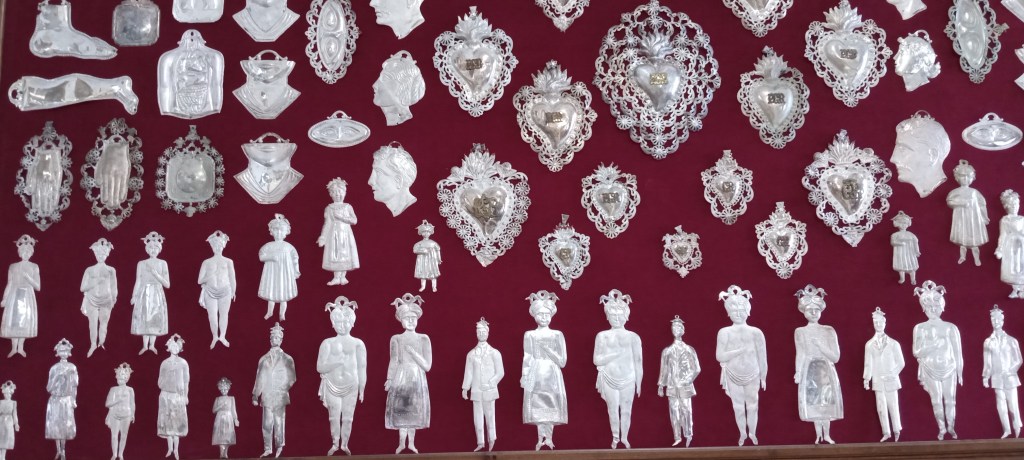
Votives at il Sanctuario di Montevergine – Italia courtesy of “Anton”
 ANTON CIRCLES HIS WORLD